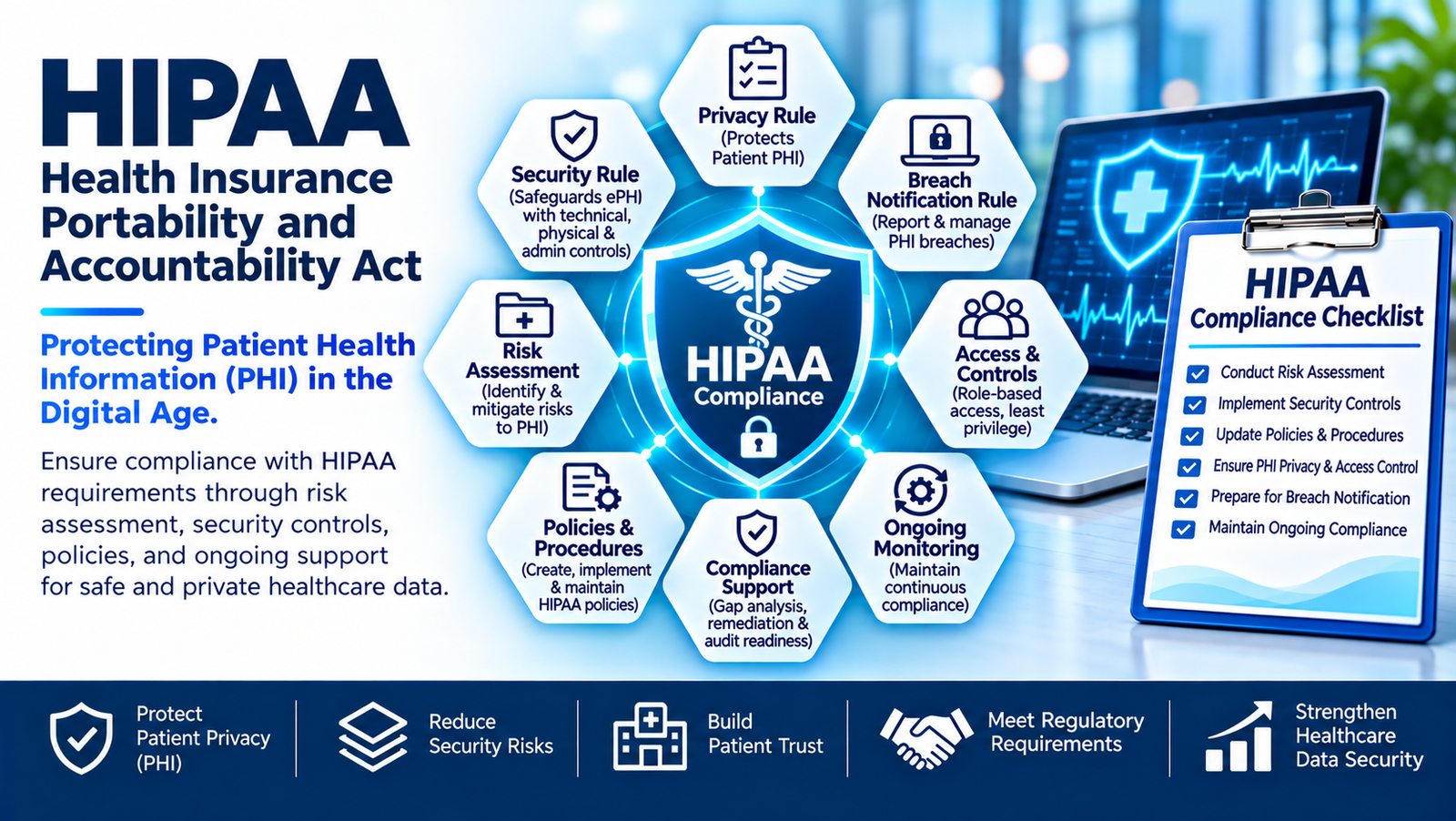
The Health Insurance Portability and Accountability Act (HIPAA) is a U.S. federal law that establishes requirements for protecting the privacy, security and confidentiality of healthcare information. HIPAA applies to doctors, hospitals, insurance companies and third-party vendors like billing services or IT providers that create, receive, maintain or transmit protected health information (PHI).
HIPAA compliance helps organisations implement safeguards to protect sensitive patient information from unauthorized access, disclosure, alteration, or loss.
HIPAA Compliance Support assists organizations in understanding applicable requirements, assessing compliance gaps, implementing policies and procedures, strengthening security controls and preparing for compliance audits and customer requirements.
A well-implemented HIPAA compliance program helps organizations protect healthcare information, reduce privacy and security risks and build confidence among customers and healthcare partners.
Practical support for healthcare providers, digital health companies, and business associates handling Protected Health Information (PHI), helping them strengthen privacy, security, and compliance readiness.
Practical HIPAA compliance and risk-reduction support to strengthen privacy controls, protect PHI, and prepare for customer audits and security reviews.
Practical, risk-based HIPAA compliance support for healthcare technology providers, helping them protect PHI, strengthen controls, and prepare for sustainable U.S. market growth.
FAQ
HIPAA is a U.S. law that establishes requirements for protecting the privacy and security of patient health information.
Doctors, hospitals, insurance companies, and third-party vendors like billing services or IT providers that create, receive, maintain, or transmit protected health information (PHI).
PHI refers to individually identifiable health information that is created, received, stored, or transmitted by covered entities or business associates.
HIPAA is a U.S. regulation, but organizations outside the U.S. may need to comply if they provide services to HIPAA-covered entities or process PHI.
A HIPAA risk assessment evaluates potential risks and vulnerabilities affecting the confidentiality, integrity, and availability of protected health information.
The Security Rule establishes requirements for administrative, physical, and technical safeguards to protect electronic PHI.
The Privacy Rule governs how protected health information may be used, disclosed, and safeguarded.
Yes. Software providers handling PHI on behalf of healthcare organizations are often required to meet HIPAA obligations as Business Associates.
Yes. Healthcare startups handling PHI should implement appropriate privacy and security controls from an early stage.
Yes. We can assess your existing processes, identify compliance gaps, and provide recommendations for improvement.
Fill in the form and our team will get back to you shortly.
Reach our regulatory experts directly.