500+ Clients
20+ Years Experience
CDSCO Experts
Pan India Support
Cybersecurity Services

Quick Snapshot

  • Service – FDA Cybersecurity Documentation Support
  • Who Can Apply – Medical Device Manufacturers, SaMD Developers, Digital Health Companies, Healthcare Technology Organizations, and Connected Device Manufacturers
  • Timeline – Project timelines depend on device complexity, software functionality, existing documentation, cybersecurity maturity, and submission requirements.
  • Fee – Consultancy fees are determined based on product complexity, documentation scope, cybersecurity requirements, and regulatory support needs.

What is Risk Management & Threat Modelling & Why Does It Matter?

Every product, system, or software application faces risks. Some risks may affect business operations, while others can impact data security, product performance, regulatory compliance, or even patient safety in the case of medical devices.

Risk Management and Threat Modelling help organizations identify potential threats, understand vulnerabilities, and implement appropriate controls before issues become real-world problems.

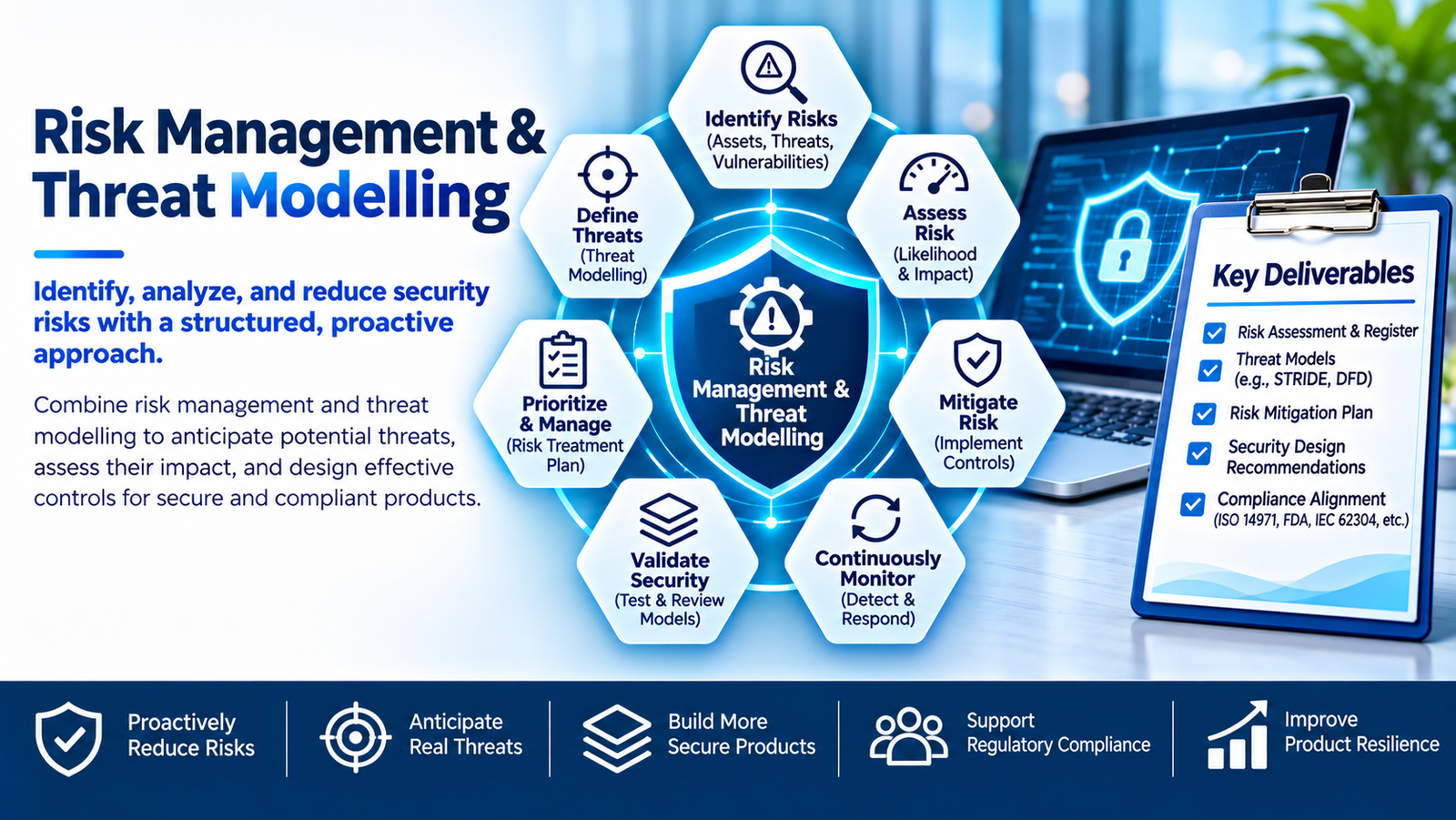
Risk Management focuses on identifying, assessing, evaluating, and controlling risks throughout the product or system lifecycle. Threat Modelling helps organizations think like an attacker by identifying potential attack paths and security weaknesses during design and development.

Together, they help organizations:

  • Identify potential risks early
  • Improve product and system security
  • Reduce cybersecurity vulnerabilities
  • Support informed decision-making
  • Enhance product quality and reliability
  • Strengthen patient and user safety
  • Support regulatory and customer expectations
  • Build confidence in products and services

A proactive approach to risk management helps organizations address potential issues before they affect business operations or end users.

When Do You Need Risk Management & Threat Modelling?

Structured support for identifying, assessing, and managing product and cybersecurity risks across the development lifecycle, from design through post-market activities.

When Do You Need?
  • Developing a new product or software application
  • Designing connected or network-enabled devices
  • Building medical devices with software components
  • Implementing cybersecurity controls
  • Launching cloud-based platforms or services
  • Managing product lifecycle risks
  • Preparing for regulatory submissions
  • Updating existing products with new features
  • Improving product security and reliability
Who Can Benefit?
  • Medical device manufacturers
  • Software companies
  • Healthcare technology providers
  • SaaS organizations
  • Connected product developers
Key Challenges
  • Risks identified too late: Many organizations address risks only after development is completed, leading to additional effort, delays, and increased costs.
  • Limited visibility of security threats: Without a structured assessment process, potential attack scenarios may go unnoticed.
  • Incomplete risk documentation: Organizations often struggle to maintain clear and traceable risk-management records.
  • Evolving cybersecurity threats: New threats continue to emerge, making ongoing risk assessment essential.
  • Balancing security and business objectives: Implementing security controls while maintaining usability and performance can be challenging.
  • Tacit Medtek helps organizations establish practical risk-management and threat-modelling processes that support both security and business objectives.

Our Approach and What You Will Get

Structured risk-management and threat-modelling support to identify security threats, evaluate risks, define controls, and maintain clear documentation across the product lifecycle.

Our Approach
  • Understanding the Product or System: We begin by reviewing your product, software, system architecture, business processes, and intended use.
  • Risk Identification: Our team works with stakeholders to identify potential hazards, vulnerabilities, and cybersecurity threats.
  • Threat Modelling Activities: We analyse possible attack scenarios, threat actors, attack surfaces, and security weaknesses.
  • Risk Assessment & Evaluation: Identified risks are assessed based on likelihood, impact, and overall business or product risk.
  • Risk Control Recommendations: We help define appropriate mitigation measures and security controls.
  • Documentation & Traceability: All activities are documented to support risk management, cybersecurity programs, and regulatory requirements.
What You Will Get (Deliverables)
  • Risk Management Plan
  • Risk assessment documentation
  • Risk analysis reports
  • Risk evaluation reports
  • Risk control measures documentation
  • Risk register
  • Threat-modelling reports
  • Threat identification and analysis
  • Attack-surface analysis
  • Security architecture review
  • Cybersecurity risk assessment
  • Risk traceability matrix
  • Security control recommendations
  • Risk review templates
  • Risk monitoring support
  • Implementation guidance
  • Documentation support
  • All documentation is prepared according to your product, technology, business environment, and applicable regulatory or customer requirements.

Why Choose Tacit Medtek and Case Example

Practical, risk-based support for identifying threats, evaluating risks, strengthening security controls, and maintaining clear product-risk documentation.

Why Choose Tacit Medtek?
  • Practical Risk-Based Approach: We focus on identifying and managing risks that matter most to your organization and products.
  • Industry Knowledge: Our team understands the challenges faced by medical device manufacturers, software developers, and technology organizations.
  • Customized Solutions: Every assessment is tailored to your product, technology, and business objectives.
  • Clear and Actionable Guidance: We provide practical recommendations that can be effectively implemented.
  • End-to-End Support: From initial risk identification to mitigation planning and documentation, we support organizations throughout the process.
Case Example
  • Challenge: A medical device company was developing a connected monitoring device and wanted to better understand potential cybersecurity and product-related risks before moving into the final stages of development. The organization needed a structured approach to identify threats, evaluate risks, and strengthen security controls.
  • Our Approach: Tacit Medtek worked closely with the development and quality teams to review the device architecture, identify potential threat scenarios, and conduct a detailed risk assessment. We helped document risks, evaluate their impact, and recommend practical measures to reduce potential vulnerabilities.
  • Outcome: The organization gained greater visibility into product risks, improved cybersecurity planning, and established a more structured approach to risk management. This helped strengthen product security and increased confidence in the overall development process.

FAQ

Frequently Asked Questions

01
What is Risk Management?

Risk Management is the process of identifying, evaluating, and controlling risks that could affect a product, system, business operation, or project.

02
What is Threat Modelling?

Threat Modelling is a structured activity used to identify potential security threats, attack paths, and vulnerabilities within a system or product.

03
Why is Threat Modelling important?

Threat Modelling helps organizations identify security concerns early and implement controls before products are released.

04
Who can benefit from Risk Management & Threat Modelling?

Medical device manufacturers, software companies, SaaS providers, healthcare organizations, and any business developing digital products can benefit from these activities.

05
Do you provide documentation support?

Yes. We provide complete documentation, templates, reports, and implementation guidance based on your specific requirements.

Enquire Now

Send Enquiry

Fill in the form and our team will get back to you shortly.

Your information is secure and will never be shared.

Send Message